Contemporary Architectural Trends: How Marrakech is Reinventing the Luxury Villa
Discover how contemporary architecture is transforming the luxury villa in Marrakech, blending open volumes, natural materials, privacy, landscaping, and new technologies.
Architecture
Safa

Introduction
Marrakech has always maintained a special relationship with architecture. From the riads of the Medina to the grand estates of the Palmeraie, the city has built itself around a balance between intimacy, light, natural materials, and connection to the landscape. Today, a new generation of villas is reinterpreting these codes with a much more contemporary approach. Lines are becoming cleaner, volumes more generous, and indoor spaces are opening up more to gardens, terraces, and pools. This evolution does not seek to erase Marrakech's architectural identity; it simply translates it into a more modern language.
The return of the single-story villa
Among the most visible trends in Marrakech's high-end market, the single-story villa now occupies a significant position.
This type of design creates a much more fluid connection between the various living spaces.
The living room, bedrooms, terraces, garden, and swimming pool can all be arranged on one level, with fewer disruptions between the interior and exterior.
Beyond aesthetics, the single-story layout also brings true day-to-day comfort.
It facilitates movement and makes it possible to design villas where every room enjoys direct access to nature.
This philosophy is especially at the heart of W Resort 2, whose 52 villas are designed as independent single-story villas.
An architecture focused on light
Natural light has become one of the central elements of the contemporary villa in Marrakech.
Large bay windows are progressively replacing more traditional openings to bring more light into the living spaces.
Living rooms open onto terraces.
Bedrooms lead directly into the gardens.
Views are carefully planned right from the design phase.
In some projects, double-height ceilings further enhance this sense of volume and allow for the creation of spectacular spaces without resorting to excessive decoration.
The goal is no longer simply to have a large villa.
It is about creating an impression of space, calm, and continuity.
The boundary between interior and exterior disappears
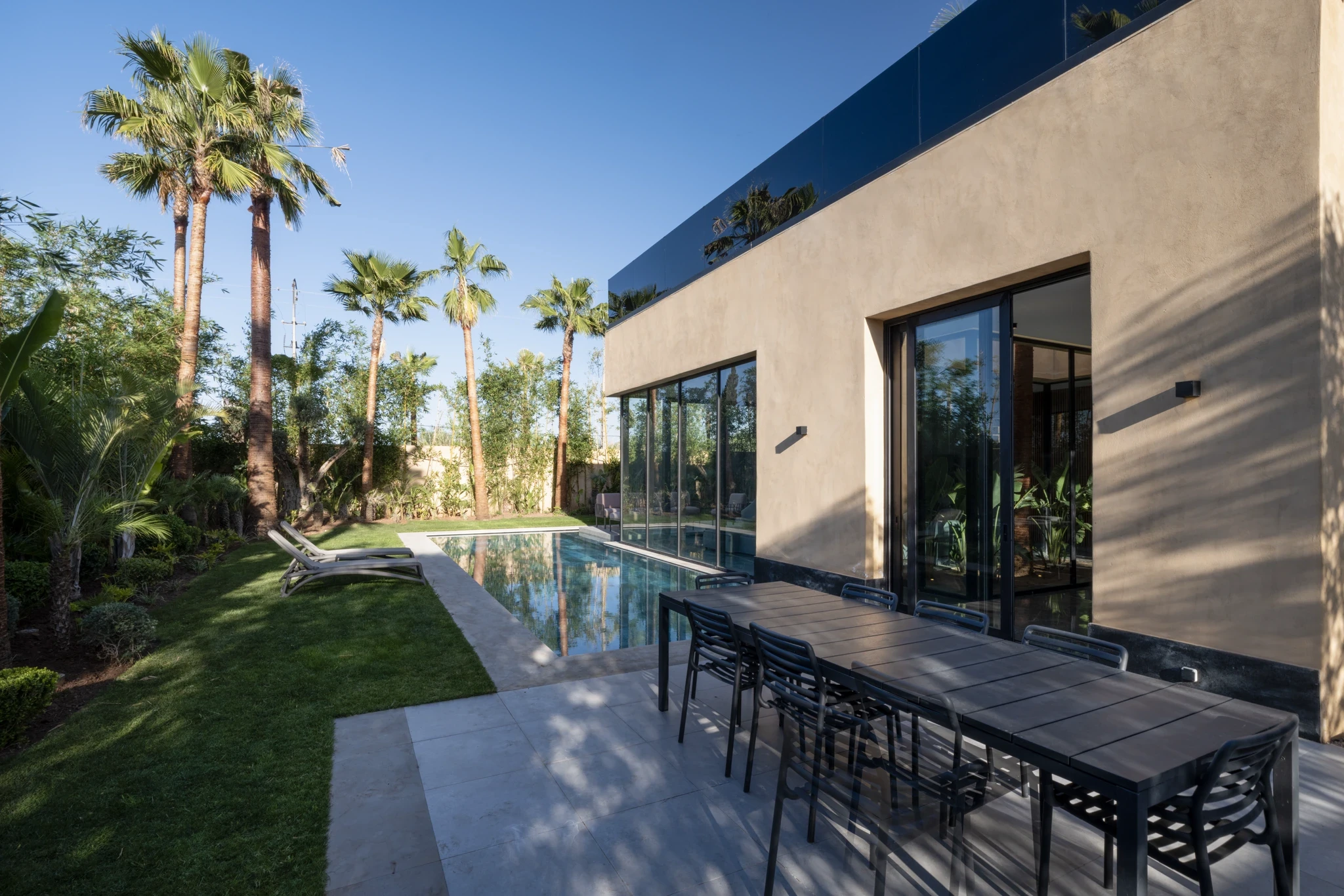
In Marrakech, a large part of daily life can take place outdoors for most of the year.
Contemporary architecture now takes this reality much more into account.
Interior and exterior spaces are therefore designed as a single whole.
A large bay window can transform an indoor living room into a direct extension of the terrace.
The kitchen can open up to an outdoor dining area.
The master suite can have its own access to the garden.
The pool itself becomes an architectural element visible from several rooms in the house.
This approach allows for full enjoyment of the climate while giving a sense of a much larger surface area.
Privacy becomes a true luxury
For a long time, the built area was one of the main criteria used to evaluate a high-end villa.
Today, privacy plays an equally important role.
The layout of the villas, the orientation of the openings, the vegetation, and the distances between each property must be studied to limit being overlooked.
A villa can feature spectacular architecture, but lose much of its appeal if the terrace or pool is directly exposed to neighboring properties.
New projects therefore strive more to create true private spaces.
W Resort 2 particularly highlights secluded villas, with no overlooking neighbors, in a low-density estate built across 7.5 hectares.
More natural and timeless materials
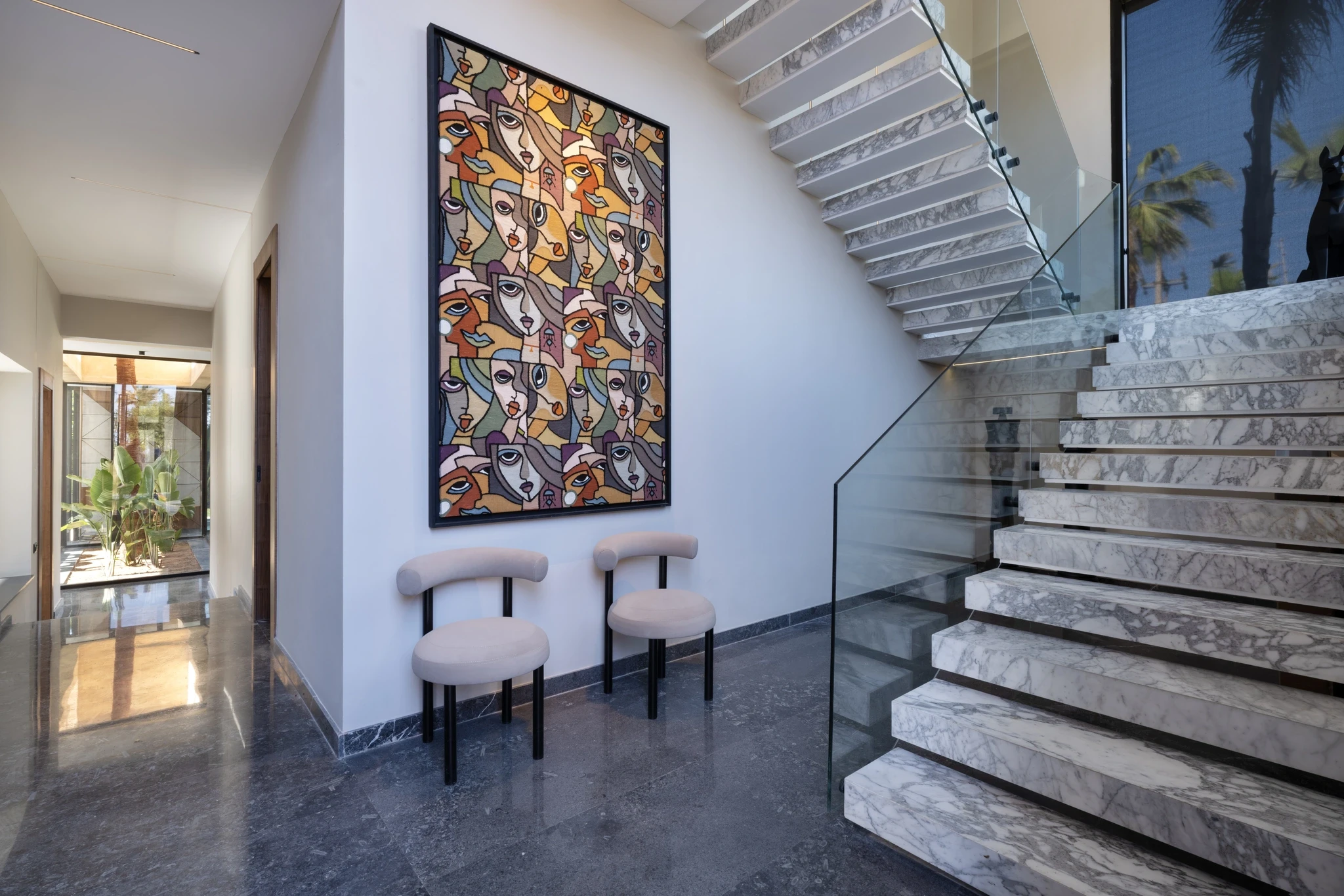
The evolution of luxury architecture in Marrakech also extends to materials.
Highly decorative interiors are gradually giving way to more understated palettes.
Natural stone, marble, wood, mineral coatings, and warm-toned textiles help create more timeless spaces.
The goal is generally to avoid overly pronounced trends.
Visual richness comes more from the texture of the materials, the light, and the quality of details than from an accumulation of decorative elements.
This approach works particularly well in Marrakech, where natural tones easily dialogue with the desert landscape and the colors of the city.
The landscape is part of the architecture
In a contemporary villa, the garden is no longer simply the remaining space around the building.
It is an integral part of the project.
The placement of trees, perspectives, shaded areas, and views from different rooms must be anticipated right from the design stage.
In Marrakech, this approach becomes even more important due to the climate.
Vegetation notably helps create natural shade zones and improves the comfort of outdoor spaces.
Palm trees, olive trees, Mediterranean plants, and species adapted to local conditions help construct a coherent landscape while managing maintenance and water needs.
In projects located on the Ourika Road, the architecture can also be organized around perspectives toward the Atlas Mountains.
W Resort 2 specifically emphasizes a landscape design integrated with the land, as well as views toward the Atlas.
The swimming pool as an architectural element
In contemporary luxury villas, the swimming pool is no longer just an additional amenity.
It directly participates in the composition of the project.
Its location can extend the lines of the villa, create a perspective from the living room, or become the central point of the garden.
Pools with simple lines integrate particularly well with minimalist architectures.
They also reinforce this connection between indoor and outdoor spaces that characterizes a large portion of Marrakech's new villas.
Better adaptation to the climate
Contemporary architecture is not limited to appearance.
Thermal comfort is also becoming an essential challenge.
Marrakech experiences particularly hot summers and significant temperature variations throughout the year.
A well-designed villa must therefore take into account:
The orientation of the building
The quality of insulation
Solar protection of the glazing
Ventilation
Shaded areas
The performance of air conditioning systems
The choice of materials
Good design helps limit energy needs while improving indoor comfort.
Technology becomes invisible
The smart home is gradually integrating into high-end residential projects.
Lighting, air conditioning, security, shutters, or access control can now be centralized.
However, the current trend is less about showing off technology and more about making it almost invisible.
It should simplify daily life without turning the house into a technological showcase.
Equipment is therefore integrated more during the design phase in order to preserve the architectural purity of the spaces.
Less density, more space
Another major shift relates to the way residential estates are designed.
High-end buyers are increasingly looking for low-density projects.
The goal is to achieve:
More green spaces
Greater distance between villas
Better privacy
Less traffic
A quieter environment
This approach brings more value to the land and to the general environment of the project.
W Resort 2 follows this precise logic with only 52 villas spread over a private estate of 7.5 hectares.
Architecture serving the lifestyle
The contemporary villa in Marrakech is therefore no longer defined solely by its size or by the value of the materials used.
Its quality depends above all on how well it responds to the lifestyle of its occupants.
Natural light, privacy, relationship with the garden, fluid circulation, thermal comfort, and outdoor spaces are becoming the new markers of luxury.
This shift explains why the most interesting projects today aim to create a complete residential experience rather than just a simple house.
Marrakech develops its own contemporary language
Marrakech's architecture continues to evolve without losing its identity.
The new Moroccan villa does not necessarily seek to replicate the traditional riad.
Instead, it retains certain of its essential principles: privacy, coolness, light, vegetation, and connection to the outdoors.
These principles are then reinterpreted through simpler lines, large volumes, and modern technologies.
The result is an architecture that is more international, yet still deeply adapted to the climate and lifestyle of Marrakech.
FAQ
Discover our articles
Also worth discovering


Our Achievements
Discover our projects
For over 30 years, our family group has been developing residential projects in Morocco, with a presence in Marrakech since 2004. Each development is built on the same approach: thoughtful architecture, carefully selected materials, and details designed to enhance daily life.